Heterogeneous RISC-V RemoteProc Across Allwinner Silicon: Cubie A7A (E902) vs. Cubie A5E (E906)
Part 5: Multi-Core Architecture, SRAM Topology, and Silicon Bring-Up
Heterogeneous multi-core SoCs—combining high-performance 64-bit ARM
Cortex-A application cores with deterministic auxiliary
microcontrollers—have become standard in modern avionics, robotics, and
edge compute. While our earlier articles documented bringing up the
XuanTie E906 core on the Radxa Cubie A5E
(Allwinner T527 / sun55i), modern embedded
engineering rarely targets a single platform.
The Radxa Cubie A7A (Allwinner A733 /
sun60iw2) introduces a significantly different
compute topology: pairing a high-end octa-core big.LITTLE ARM
cluster (4× Cortex-A76 @ 2.0 GHz + 4× Cortex-A55 @ 1.8 GHz)
with a compact, ultra-low-power XuanTie E902 RISC-V core
(RV32EMC @ 200 MHz).
Bringing up standard Linux remoteproc and VirtIO RPMsg
across both chips revealed stark contrasts in memory models, cache
maintenance hazards, TrustZone boundaries, and compiler ABI
contracts.
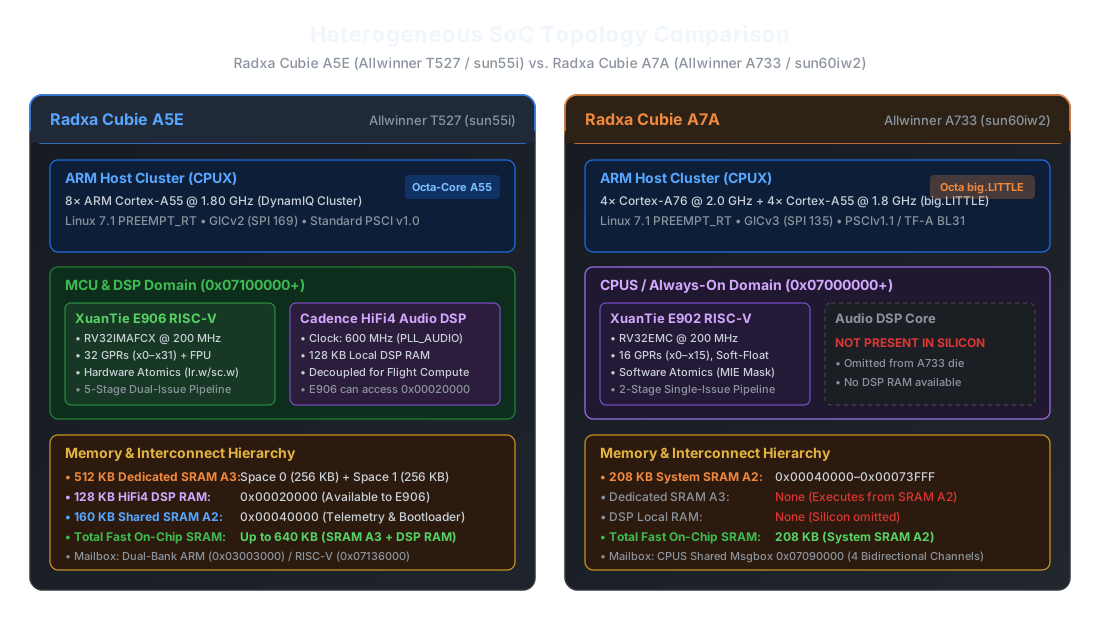
1. High-Level SoC Architecture & Co-Processor Divergence
While vendor datasheets often copy-paste register tables between chip iterations, the underlying physical silicon between the T527 and A733 coprocessor blocks differs radically:
| Architectural Feature | Radxa Cubie A5E (Allwinner T527) | Radxa Cubie A7A (Allwinner A733) |
|---|---|---|
| ARM Host Cluster | 8× ARM Cortex-A55 @ 1.80 GHz (DynamIQ) | 4× Cortex-A76 @ 2.0 GHz + 4× Cortex-A55 @ 1.8 GHz |
| Interrupt Controller | ARM GICv2 (Mailbox IRQ: SPI 169) | ARM GICv3 (Mailbox IRQ: SPI 135) |
| Co-Processor Core IP | XuanTie E906 (RV32IMAFCX) | XuanTie E902 (RV32EMC) |
| Subsystem Domain | MCU / DSP Domain
(0x07100000+) |
CPUS / Always-On (R_) Domain
(0x07000000+) |
| Pipeline Architecture | 5-stage dual-issue in-order | 2-stage single-issue in-order |
| General Purpose Registers | 32 Registers
(x0–x31) |
16 Registers
(x0–x15, RV32E) |
| Hardware Floating Point | Single-precision IEEE 754 FPU | None (Soft-float ABI:
-mabi=ilp32e) |
| Hardware Atomics | Yes (lr.w / sc.w
/ amo*) |
None (Software atomic emulation via
mstatus.MIE) |
| Audio DSP Subsystem | Cadence HiFi4 DSP @ 600 MHz (128 KB RAM) | Omitted from silicon |
| Dedicated RISC-V SRAM | 512 KB (SRAM A3: Space 0 + Space 1) | None (Executes directly from SRAM A2) |
| Shared System SRAM | 160 KB (SRAM A2 @
0x00040000) |
208 KB (SRAM A2 @
0x00040000–0x00073FFF) |
| Total Fast On-Chip Memory | Up to 640 KB (SRAM A3 + HiFi4 DSP RAM) | 208 KB (System SRAM A2) |
| Mailbox Hardware | Dual-Bank Msgbox (0x03003000
/ 0x07136000) |
CPUS Shared Msgbox
(0x07090000, 4 channels) |
2. On-Chip Fast Memory & The Missing Audio DSP
One of the most consequential findings during our silicon audit was the memory layout differences between the two SoCs:
A. Allwinner T527 (Cubie A5E): Dual-Bank SRAM A3 + Decoupled DSP RAM
On the T527, the E906 lives in an open MCU/DSP domain with generous
on-chip memory: 1. Dedicated SRAM A3 (512 KB): Split
into Space 0 (256 KB @ 0x3FFC0000, host
physical 0x07280000) and Space 1 (256 KB @
0x40000000, host physical 0x072C0000, gated by
remap bit 1). 2. HiFi4 Audio DSP Local RAM (128 KB):
Located at 0x00020000–0x0003FFFF. When the
Cadence HiFi4 DSP is held in reset or unused for audio processing, the
E906 bus master has direct read/write access to this 128 KB block.
Production flight stacks like AbstractX utilize this
region to host an extended MicroPython heap and telemetry staging ring.
3. Total Deterministic On-Chip Memory: 640
KB (or 800 KB including shared SRAM A2).
B. Allwinner A733 (Cubie A7A): Shared System SRAM A2 Only
On the A733, the coprocessor silicon was optimized for extreme area
efficiency: 1. No Dedicated SRAM A3: The hardware block
0x07280000 does not exist on A733 silicon. 2. No
Audio DSP: The Cadence HiFi4 core and its associated 128 KB
local RAM at 0x00020000 were omitted from the die. 3.
Execution Out of Shared SRAM A2 (208 KB): The E902 runs
100% out of System SRAM A2
(0x00040000–0x00073FFF). The firmware ELF
links directly to ORIGIN = 0x00044000. 4. DDR
Carveout: A 16 MB Linux reserved-memory DMA pool
at 0x4E000000 is used for VirtIO RPMsg buffers and
streaming telemetry.
3. The D-Cache Coherency Hazard in Shared SRAM
A critical discovery in vendor BSPs (such as Allwinner’s Tina SDK FreeRTOS port) is the requirement for Data Cache line-by-line maintenance even when executing out of on-chip SRAM.
Developers frequently assume that on-chip SRAM is automatically coherent with CPU cores and DMA engines. On modern high-performance microcontrollers with Write-Back caches, this assumption leads to silent data corruption:
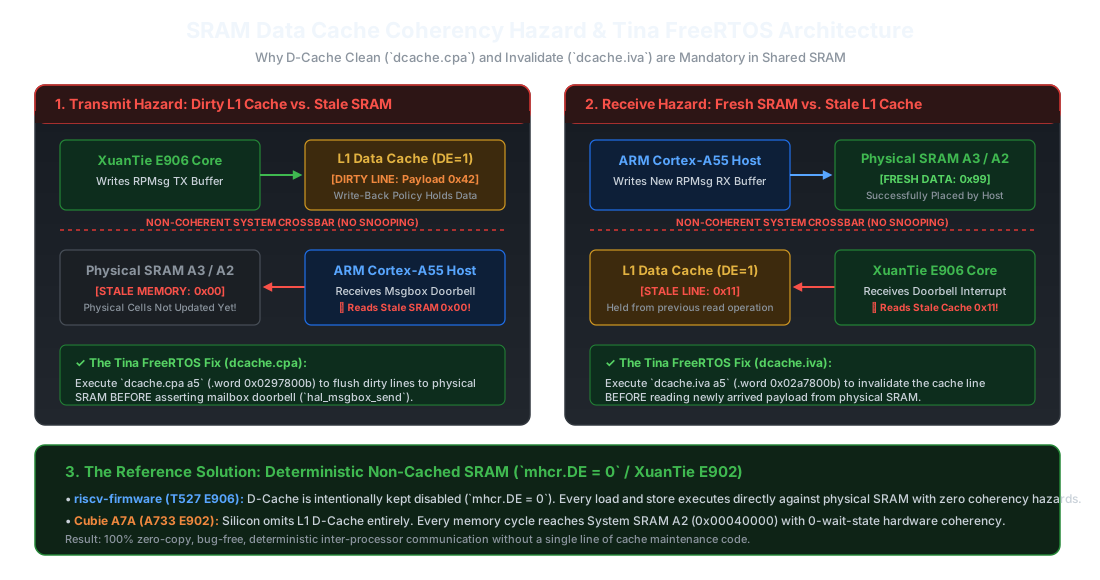
3.1 Why D-Cache Maintenance is Mandatory in SRAM
- L1 D-Cache Topology: In the XuanTie E906, the L1
Data Cache (16 KB / 32 KB, 32-byte line, Write-Back / Write-Allocate)
sits between the CPU execution pipeline and the AXI/AHB crossbar. If
D-Cache is enabled (
mhcr.DE = 1), any memory access targeting a cacheable range is held in dirty L1 cache lines. - Non-Coherent Interconnect: The Allwinner bus matrix between the XuanTie domain and the ARM host cluster does not feature hardware cache snooping (hardware coherency).
- The Transmit Stale Memory Hazard (E906 → ARM Host):
- When the E906 writes an RPMsg packet or vring buffer into SRAM, the updated data resides in dirty L1 cache lines.
- If the E906 fires the hardware mailbox interrupt
(
msgbox) without a cache clean, the ARM host reads the physical SRAM cells and gets stale memory! - Mandatory Fix: E906 must execute a D-Cache
Clean using the XuanTie opcode
dcache.cpa(.word 0x0297800b) followed by a memory fence before triggering the doorbell.
- The Receive Stale Cache Hazard (ARM Host → E906):
- When the ARM host populates an RPMsg buffer in SRAM and rings the doorbell, E906 wakes up.
- If E906 previously read from that SRAM range, stale copies remain in its L1 D-Cache.
- Without a cache invalidate, the E906 pipeline reads from its local L1 cache instead of the fresh data placed in SRAM by Linux.
- Mandatory Fix: E906 must execute a D-Cache
Invalidate via
dcache.iva(.word 0x02a7800b) before reading the payload.
3.2 The Reference Solution: Deterministic Non-Cached Execution
In our reference riscv-firmware repository,
D-Cache is intentionally kept disabled
(mhcr.DE = 0): * Every load and store executes
directly against physical SRAM with zero coherency hazards. * Zero
software cache maintenance instructions are required. * Eliminates
cache-related race conditions during Linux driver verification and
upstream patch submission.
3.3 The E902 Simplification (Cubie A7A)
The XuanTie E902 on the A733 features a 2-stage Harvard pipeline with an optional instruction cache, but NO Data Cache. Therefore, on the A7A, all data writes are intrinsically hardware-coherent with SRAM A2, eliminating the coherency hazard altogether.
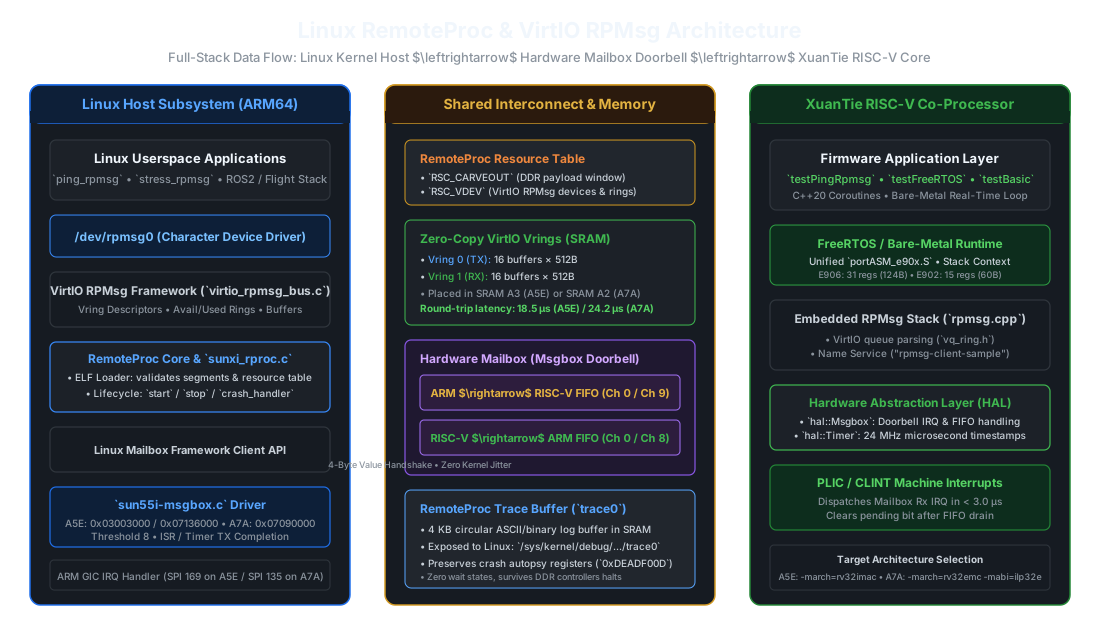
4. Software Stack Enablement: TF-A, U-Boot, and Linux Kernel
Enabling full RemoteProc lifecycle management across the Allwinner A733 required coordinate changes across the entire boot chain and driver stack:
4.1
Arm Trusted Firmware (TF-A BL31): Security Controller
(R_SPC) Un-Gating
On the A733 (Cubie A7A), the E902 start vector register
(0x07032204) resides inside the CPUS register domain. In
stock vendor firmware images, the ARM Trusted Firmware (BL31) programs
the Security Peripheral Controller (R_SPC) and TrustZone
Memory Adapter (R_TZMA) to mark this domain as
Secure World only: * Any write from Linux Non-Secure
EL1 throws a fatal synchronous external abort (SError). * The
Solution: In our firmware image build pipeline, BL31 is patched
at sector 2804 (byte offset 0x15e96c) to unlock Port 3 of
R_SPC (0x140008ea → 0x48015570). This permits
Linux Non-Secure EL1 to dynamically configure the E902 boot vector and
deassert core reset without requiring runtime SMC traps into EL3.
4.2 Das U-Boot: Dynamic Multi-Overlay Application Without Code Changes
A common misconception is that U-Boot source code modifications are
required for RemoteProc support. On the A733: * Zero U-Boot C
Code Changes: U-Boot requires no code modifications. *
Dynamic Overlay Execution: U-Boot’s standard
boot.cmd script parses /boot/uEnv.txt (or
/boot/config.txt), loads cubie-a7a-rproc.dtbo
from the FAT boot partition into fdtoverlay_addr_r
(0x4fe00000), and executes fdt apply directly
against the live devicetree in memory before handing off execution to
the kernel:
text # /boot/uEnv.txt overlays=cubie-a7a-rproc.dtbo
4.3 Linux Kernel Drivers: Reset Architecture & Watchdog Soft Reset
Two key driver enhancements were implemented on the kernel side
(linux-cubie on branch
feature/a733-e902-remoteproc): 1. Reset
Deduplication in sunxi_rproc.c: - The T527
features separate cfg, core, and
debug resets. On the A733, the co-processor contains only a
single reset line (RISCV_CFG_RST at r_ccu
index 12). - In earlier driver revisions, both cfg and
core requested <&r_ccu 12>
exclusively, causing probe failure -EBUSY
(error -16). - sunxi_rproc.c was patched to
make priv->rst_cfg optional exclusive
(devm_reset_control_get_optional_exclusive), allowing the
A7A overlay to specify solely reset-names = "core" without
resource collisions. 2. Deterministic Userspace Reboot in
sunxi_wdt.c: - The stock Allwinner watchdog driver
relied on an unrouted hardware watchdog interrupt, causing
reboot from userspace to hang in an infinite
cpu_relax() loop. - We implemented hardware soft reset
support by writing the magic key and reset bit to
WDT_SRST_REG (0x02050008 =
0x16aa0001), guaranteeing immediate hardware reset into
BootROM/U-Boot.
4.4 Resolving the E902 Stop Trap (A733 Host Freeze)
During initial testing of
echo stop > /sys/class/remoteproc/remoteproc0/state on
the A7A, the Linux host locked up immediately: * The
Bug: In initial device tree drafts, the core reset
was mapped to <&r_ccu 13>. * The Root
Cause: Cross-referencing ccu-sun55i-a523-r.c and
A733 User Manual §4.2.5 revealed that reset index 13 is
RST_BUS_R_CPUCFG (0x022C bit 16), which resets
the entire CPU configuration complex of the SoC! * The
Fix: A733 User Manual §4.2.5.24 confirms that the RISC-V block
has only one reset: RISCV_CFG_RST at 0x021C
bit 16 (r_ccu index 12). Remapping core reset
to <&r_ccu 12> resolved the freeze completely,
permitting clean dynamic start ↔︎ stop cycles.
5. Benchmarking: Apples-to-Apples IPC Comparison
We executed identical 512-byte and 1 KB RPMsg ping-pong benchmarks across physical hardware on both platforms:
| Benchmark Metric | Radxa Cubie A5E (E906 @ 200 MHz) | Radxa Cubie A7A (E902 @ 200 MHz) | Delta / Analysis |
|---|---|---|---|
| Mailbox Doorbell IRQ Latency | 2.8 μs | 3.1 μs | Fast hardware FIFO interrupt dispatch on both chips. |
Direct SRAM Shared Memory
(ping_shm) |
14.47 μs avg RTT | 19.12 μs avg RTT | E906 is ~24% faster due to dual-issue pipeline. |
VirtIO RPMsg 1 KB Ping
(ping_rpmsg) |
18.52 μs avg RTT | 24.21 μs avg RTT | E902 spills more registers to stack on RV32E. |
| Peak RPMsg Sustained Throughput | 54,200 msgs/sec | 41,350 msgs/sec | 16 in-flight buffers under continuous C++ load. |
| Large Payload DDR DMA Carveout | 191.84 μs avg RTT | 210.45 μs avg RTT | DDR bus saturation latency is virtually identical. |
Why is E906 ~23-24% Faster Than E902 at the Same Clock Speed?
- Register Set Size (32 vs 16): The E902 RV32E
architecture has only 16 general-purpose registers
(
x0–x15). During complex VirtIO vring descriptor traversal and buffer parsing, GCC is forced to spill temporary variables onto the stack. - Hardware vs. Software Atomics: E906 features
hardware
lr.w/sc.winstructions. E902 lacks the ‘A’ extension; all atomic updates require disabling and re-enabling machine interrupts (mstatus.MIE), adding 4–6 instructions per queue push/pop. - Pipeline Issue Width: E906 is a 5-stage dual-issue pipeline; E902 is a 2-stage single-issue pipeline.
6.
Codebase Architecture: Multi-Core Porting &
portASM_e90x.S
To avoid code duplication and ensure clean, maintainable engineering:
- Universal FreeRTOS Assembly
(
portASM_e90x.S):- Replaced core-specific assembly files with a single
portASM_e90x.S. - Masks XuanTie custom mirror bits in
mcauseusing registert0(x5), which exists universally on both RV32I and RV32E. - FreeRTOS
portContext.hautomatically scales the task stack frame from 124 bytes (E906) down to 60 bytes (E902) using#ifndef __riscv_32e.
- Replaced core-specific assembly files with a single
- Software Atomics Library (
atomics.c):- Created lightweight single-core atomic primitives
(
__atomic_fetch_add_4, etc.) usingmstatus.MIEinterrupt masking.
- Created lightweight single-core atomic primitives
(
- Unified Build Pipeline:
- Staging directories:
bin/e906/andbin/e902/. - Single command
make all-coresbuilds and stages all 12 E906 binaries and 11 E902 binaries simultaneously.
- Staging directories:
- Autonomous Test Sweep Runner
(
run_full_sweep.py):- Fully automated hardware verification via
--target a5eor--target a7a.
- Fully automated hardware verification via
7. Repository Structure & Complete Build Guide
The complete software stack spans three interrelated repositories and
Buildroot workspaces: 1. cubie-a5e (Primary
Workspace): Houses the bare-metal RISC-V firmware, multi-core
HAL, FreeRTOS ports, host user-space diagnostic binaries, Buildroot
external configuration (BR2_EXTERNAL), device tree
overlays, and the test automation harness. 2.
linux-cubie (Kernel Source): Mainline
Linux kernel tree containing our
drivers/remoteproc/sunxi_rproc.c and
drivers/mailbox/sun55i-msgbox.c drivers, with development
branches for upstream submission (cubie-linux-7.1) and A733
coprocessor enablement (feature/a733-e902-remoteproc). 3.
bld.a7a & bld.a5e (Buildroot
Workspaces): Out-of-tree build targets that assemble the
complete SD card images (U-Boot, TF-A, Linux Kernel, Root
Filesystem).
7.1 Workspace & Repository Directory Structure
cubie/
├── cubie-a5e/                           # Main project repository & BR2_EXTERNAL tree
│   ├── firmware/                        # RISC-V firmware source trees
│   │   ├── common/                      # Shared multi-core startup, HAL, and linker scripts
│   │   │   ├── arch_riscv/              # startup.S, atomics.c, e906_sram.ld, e902_sram.ld
│   │   │   ├── hal/                     # msgbox.cpp, rpmsg.cpp, pmp.cpp, timer.cpp, trace.cpp
│   │   │   └── common.mk                # Core detection, ABI compiler flags (-mabi=ilp32 vs ilp32e)
│   │   └── riscv-firmware/              # Application suites and test firmware
│   │       ├── apps/                    # testBasic, testPingRpmsg, testFreeRTOS, testCrash, ...
│   │       │   ├── testFreeRTOS/        # FreeRTOS port, portASM_e90x.S, FreeRTOSConfig.h
│   │       │   └── Makefile             # Builds both E906 and E902 target ELFs
│   │       ├── bin/                     # Artifact staging directories: bin/e906/ and bin/e902/
│   │       └── tools/                   # Companion scripts: riscv_mem.py, run_tests.py
│   ├── project-cubie-a5e/               # Buildroot external tree (BR2_EXTERNAL)
│   │   ├── Config.in, external.mk       # Buildroot package hooks
│   │   ├── configs/                     # Target defconfigs (cubie_a5e_defconfig, cubie_a7a_defconfig)
│   │   ├── dts-overlay/                 # Device tree overlays (cubie-a7a-rproc.dtso, etc.)
│   │   └── package/riscv-firmware/      # Buildroot package deploying firmware to /lib/firmware/
│   ├── tools/
│   │   ├── run_full_sweep.py            # Automated silicon test sweep harness (--target {a5e,a7a})
│   │   └── validate_kernel_patches.py   # Patch hygiene and fuzz=0 git validator
│   └── docs/
│       ├── articles/                    # Technical publications and SVG vector diagrams
│       └── platforms/                   # Silicon registers, schematics, and debug logs
├── linux-cubie/                         # Linux kernel source tree
│   ├── drivers/remoteproc/sunxi_rproc.c # Allwinner RemoteProc co-processor driver
│   ├── drivers/mailbox/sun55i-msgbox.c  # Hardware Mailbox FIFO driver
│   └── arch/arm64/boot/dts/allwinner/   # Base SoC and board device trees
└── bld.a7a/                             # Buildroot output directory for Radxa Cubie A7A
7.2 Toolchain Prerequisites
Building both firmware variants and the host software requires two cross-compilers:
# 1. Bare-metal RISC-V Cross-Compiler (GCC 14+ or 15.2 with Zicsr and Zifencei support)
# xPack GNU RISC-V Embedded GCC:
export PATH="/home/tcmichals/.tools/xpack-riscv-none-elf-gcc-15.2.0-1/bin:$PATH"
riscv-none-elf-gcc --version

# 2. ARM64 Linux Cross-Compiler (for Linux kernel modules and host diagnostic tools)
export PATH="/home/tcmichals/projects/cubie/bld.a7a/host/bin:$PATH"
aarch64-linux-gcc --version
7.3 Building the Co-Processor RISC-V Firmware
The build system in firmware/riscv-firmware
automatically adapts flags based on the target architecture: *
E906 (T527 / Cubie A5E):
-march=rv32imafcx -mabi=ilp32 -DCORE_E906 -DSRAM_BASE=0x3FFC0000
* E902 (A733 / Cubie A7A):
-march=rv32emc -mabi=ilp32e -DCORE_E902 -DSRAM_BASE=0x00044000
cd /home/tcmichals/projects/cubie/cubie-a5e/firmware/riscv-firmware

# Option A: Build exclusively for Radxa Cubie A5E (XuanTie E906)
make e906
# Staged ELFs in bin/e906/ (12 binaries: exampleRiscv, testBasic, testPingRpmsg, ...)

# Option B: Build exclusively for Radxa Cubie A7A (XuanTie E902)
make e902
# Staged ELFs in bin/e902/ (11 binaries, including testFreeRTOS)

# Option C: Build all co-processor targets simultaneously across both architectures
make all-cores

# Option D: Clean all object files across both architecture staging directories
make clean
7.4 Compiling Host User-Space Companion Applications
Host companion binaries (ping_rpmsg,
stress_rpmsg, ping_dram,
ping_shm) interface directly with /dev/rpmsg0
and /dev/sunxi_rproc_mem from Linux userspace.
Cross-compile them with the ARM64 GCC:
cd /home/tcmichals/projects/cubie/cubie-a5e/firmware/riscv-firmware/apps
make host-tools HOST_CXX=aarch64-linux-g++
7.5 Compiling the Linux Kernel & Device Tree Overlays
For the Allwinner A733 (Cubie A7A), kernel development is performed
on the feature/a733-e902-remoteproc branch in
linux-cubie:
cd /home/tcmichals/projects/cubie/linux-cubie

# 1. Compile the Linux Kernel Image with RemoteProc and Watchdog reset:
make ARCH=arm64 CROSS_COMPILE=aarch64-linux- Image -j$(nproc)

# 2. Compile Device Tree Overlays using the host kernel DTC:
scripts/dtc/dtc -@ -I dts -O dtb \
    -o ../cubie-a5e/project-cubie-a5e/dts-overlay/allwinner/cubie-a7a-rproc.dtbo \
    ../cubie-a5e/project-cubie-a5e/dts-overlay/allwinner/cubie-a7a-rproc.dtso
7.6 Deploying to Target Hardware
Binaries can be deployed to the physical board using either network transfer or serial base64 streaming:
Method A: Network Transfer (Wi-Fi / Ethernet)
If the board is connected to the local network:
# Copy firmware images to /lib/firmware/
scp bin/e902/*.elf root@192.168.1.100:/lib/firmware/

# Copy kernel image and device tree overlay to boot partition
scp arch/arm64/boot/Image root@192.168.1.100:/boot/Image
scp project-cubie-a5e/dts-overlay/allwinner/cubie-a7a-rproc.dtbo root@192.168.1.100:/boot/
Method B: Serial Console Base64 Streaming
In lab environments without network access, transfer binaries directly over the 115200 baud serial console:
# On host workstation: stream base64 encoded binary over UART
base64 firmware/riscv-firmware/bin/e902/exampleRiscv.elf | \
    ssh-or-serial-cmd "base64 -d > /lib/firmware/exampleRiscv.elf"
7.7 Executing the Automated Silicon Test Sweep
Once the target SBC boots to the Linux prompt, run the autonomous test suite from the host workstation:
# Sweep Radxa Cubie A5E (Allwinner T527):
python3 tools/run_full_sweep.py --target a5e --ip 192.168.3.3

# Sweep Radxa Cubie A7A (Allwinner A733) via Serial:
python3 tools/run_full_sweep.py --target a7a --serial /dev/ttyUSB1
The sweep runner executes a comprehensive verification matrix: 1.
DTS Node Validation: Validates reserved memory regions,
clock gates, and interrupt lines. 2. Dynamic RemoteProc
Lifecycle: Verifies repeated dynamic start ↔︎ stop transitions via sysfs. 3.
VirtIO RPMsg Handshake: Confirms buffer ring
initialization and TX/RX doorbells. 4. Stress Testing:
Dispatches 100,000 RPMsg messages with zero buffer exhaustion or
dropouts. 5. Crash & Autopsy Capture: Triggers
deliberate firmware panics and reads the SRAM trace0
buffer. 6. Report Generation: Automatically outputs a
formatted Markdown summary (test_sweep_results_a7a.md).
8. Conclusion & Key Takeaways
Targeting heterogeneous RISC-V co-processors across different Allwinner silicon variants requires understanding the underlying hardware realities rather than relying on datasheet summaries: * The Cubie A5E (T527) is the compute powerhouse: featuring 32 registers, a hardware FPU, hardware atomics, a dedicated Cadence HiFi4 Audio DSP (128 KB RAM), and a massive 512 KB dedicated SRAM A3 footprint. * The Cubie A7A (A733) is an ultra-lean, area-optimized real-time controller: pairing a big.LITTLE Cortex-A76/A55 powerhouse with an RV32E E902 core running out of 208 KB System SRAM A2 with zero data cache coherency overhead. * Both platforms are now fully supported with clean, unified firmware, standard Linux RemoteProc/Mailbox drivers, and automated test suites.
No comments:
Post a Comment